

Close
![Popup Image]()
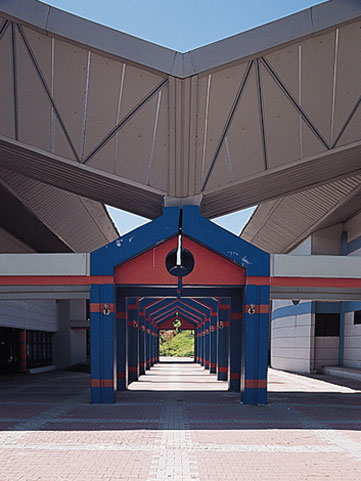
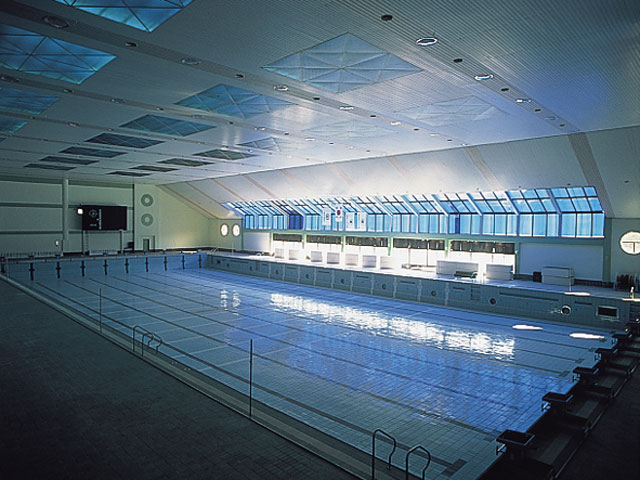
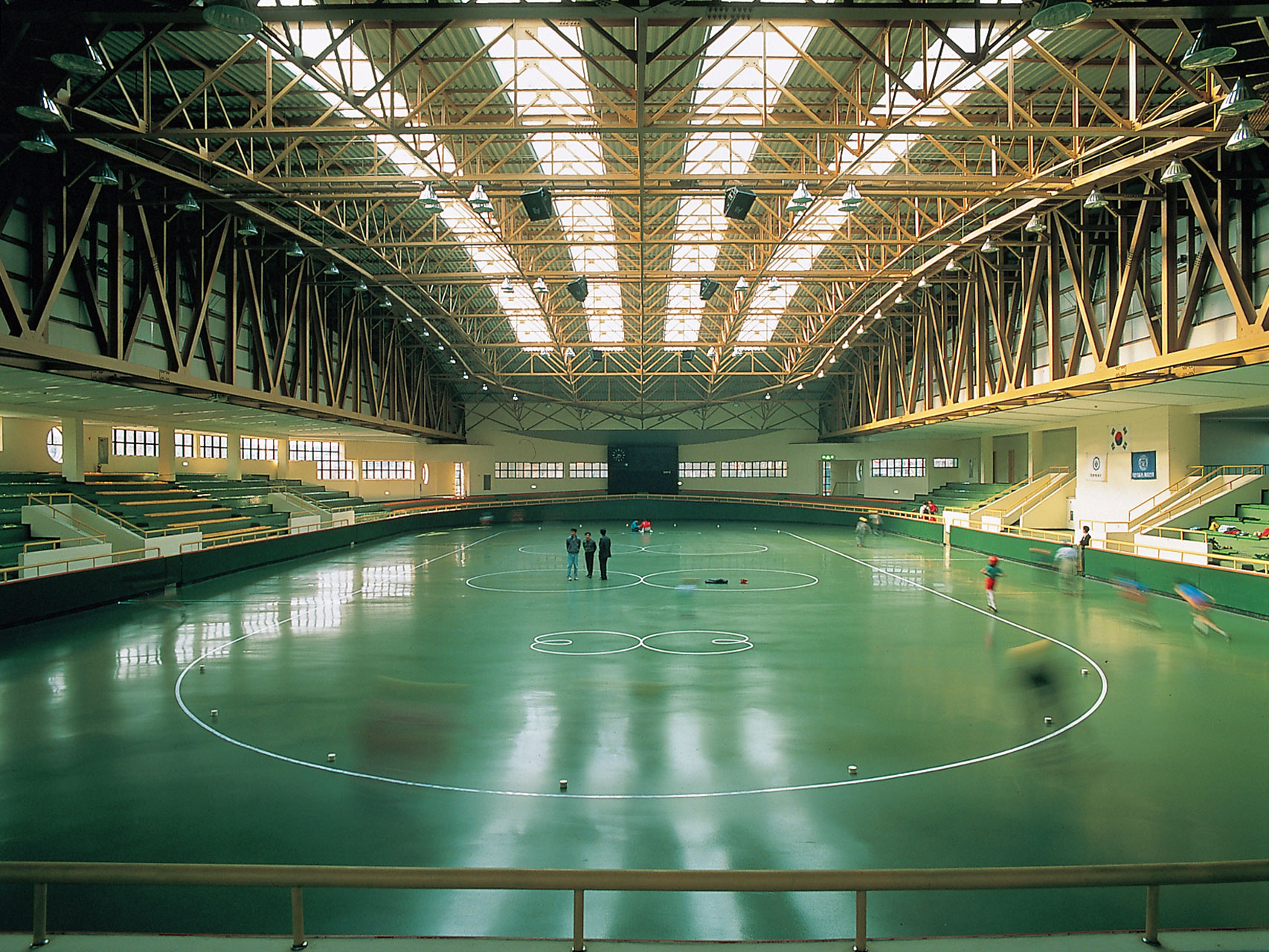
These facilities are located at the north end of Cheongju Sports Complex and were built in preparation for the 1990 National Sports Festival. Comprising, from the west, an indoor swimming pool, the Olympic Memorial Civic Center, and an inline skating rink, the facilities are wrapped in sequence by three curved roofs laid out in a row, creating a sense of order, stability, and rhythm. In doing so, they present a landmark image at the gateway to Cheongju and suggest ways to utilize large sports facilities that were increasingly demanded in society after the 1988 Olympics.
The design has two main characteristics. First, because the existing sports facilities possessed a generally disorderly formal image, the new facilities were conceived to compensate for this. Facilities accommodating different functions were integrated into a single composition to create a strong sense of order, while the theme of simple curved roofs provided horizontal stability and rhythmic form. Second, for the facilities to function as a genuine community sports complex, it needed to go beyond the passive notion of merely opening the facilities and instead allow citizens to actively experience the diverse interior and exterior spaces. Accordingly, the aim was to give this project the character of a place where exercise, rest, and gathering naturally become integrated.
The design has two main characteristics. First, because the existing sports facilities possessed a generally disorderly formal image, the new facilities were conceived to compensate for this. Facilities accommodating different functions were integrated into a single composition to create a strong sense of order, while the theme of simple curved roofs provided horizontal stability and rhythmic form. Second, for the facilities to function as a genuine community sports complex, it needed to go beyond the passive notion of merely opening the facilities and instead allow citizens to actively experience the diverse interior and exterior spaces. Accordingly, the aim was to give this project the character of a place where exercise, rest, and gathering naturally become integrated.
In the Press

-
Status
Completed
-
Order
Chungcheongbuk-do
-
Purpose
Sports, Public
-
Design Year
1989
-
Completion Year
1990
-
Location
Cheongju-si, Chungcheongbuk-do
-
Site area
77,200.00m2
-
Gross Floor Area
15,282.20m2
-
Building Area
10,195.30m2
-
Scale
B1, 3F(Community Center and Indoor Swimming Pool) / 2F(Roller Skating Rink)
These facilities are located at the north end of Cheongju Sports Complex and were built in preparation for the 1990 National Sports Festival. Comprising, from the west, an indoor swimming pool, the Olympic Memorial Civic Center, and an inline skating rink, the facilities are wrapped in sequence by three curved roofs laid out in a row, creating a sense of order, stability, and rhythm. In doing so, they present a landmark image at the gateway to Cheongju and suggest ways to utilize large sports facilities that were increasingly demanded in society after the 1988 Olympics.
The design has two main characteristics. First, because the existing sports facilities possessed a generally disorderly formal image, the new facilities were conceived to compensate for this. Facilities accommodating different functions were integrated into a single composition to create a strong sense of order, while the theme of simple curved roofs provided horizontal stability and rhythmic form. Second, for the facilities to function as a genuine community sports complex, it needed to go beyond the passive notion of merely opening the facilities and instead allow citizens to actively experience the diverse interior and exterior spaces. Accordingly, the aim was to give this project the character of a place where exercise, rest, and gathering naturally become integrated.
The design has two main characteristics. First, because the existing sports facilities possessed a generally disorderly formal image, the new facilities were conceived to compensate for this. Facilities accommodating different functions were integrated into a single composition to create a strong sense of order, while the theme of simple curved roofs provided horizontal stability and rhythmic form. Second, for the facilities to function as a genuine community sports complex, it needed to go beyond the passive notion of merely opening the facilities and instead allow citizens to actively experience the diverse interior and exterior spaces. Accordingly, the aim was to give this project the character of a place where exercise, rest, and gathering naturally become integrated.
In the Press


