

Close
![Popup Image]()
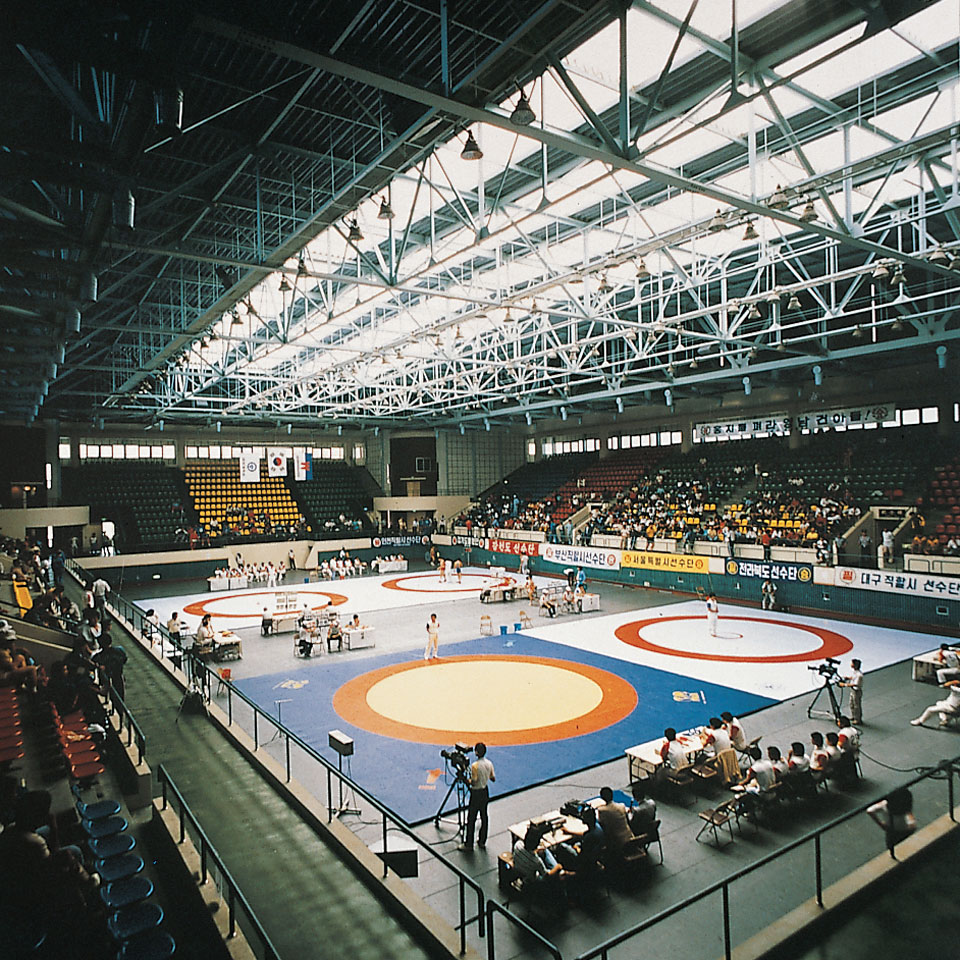
The Sangmu Gymnasium serves as the comprehensive sports facility for the Korea Armed Forces Athletic Corps (KAFAC), planned as part of a master plan for the long-term development of the Corps. It incorporates multifunctional sports facilities and residential welfare amenities. Designed primarily as a training venue for professional athletes — serving as practice arenas and fitness centers for all indoor sports — it was also configured to function as the main wrestling venue for the 1986 Seoul Asian Games and the 1988 Seoul Olympics, emphasizing seamless functionality as well as organic and flexible spatial organization.
All facilities are arranged along the solar axis, leveraging existing topography while establishing a spatial system that anticipates future expansions. Each arena is planned as flexible space for both practice matches and physical training, supported by a truss structure on four cylindrical cores to create a strong, masculine sculptural expression. Lighting is resolved through skylights to enable daylighting for all events. Following the relocation of the KAFAC headquarters to Mungyeong, Gyeongbuk Province in April 2007, the gymnasium was demolished.

-
Status
Completed
-
Order
Ministry of National Defence
-
Purpose
Public, Sports
-
Completion Year
1986
-
Location
Seongnam-si, Gyeonggi-do
-
Site area
409,200m2
-
Gross Floor Area
7,810m2
-
Scale
3F
The Sangmu Gymnasium serves as the comprehensive sports facility for the Korea Armed Forces Athletic Corps (KAFAC), planned as part of a master plan for the long-term development of the Corps. It incorporates multifunctional sports facilities and residential welfare amenities. Designed primarily as a training venue for professional athletes — serving as practice arenas and fitness centers for all indoor sports — it was also configured to function as the main wrestling venue for the 1986 Seoul Asian Games and the 1988 Seoul Olympics, emphasizing seamless functionality as well as organic and flexible spatial organization.
All facilities are arranged along the solar axis, leveraging existing topography while establishing a spatial system that anticipates future expansions. Each arena is planned as flexible space for both practice matches and physical training, supported by a truss structure on four cylindrical cores to create a strong, masculine sculptural expression. Lighting is resolved through skylights to enable daylighting for all events. Following the relocation of the KAFAC headquarters to Mungyeong, Gyeongbuk Province in April 2007, the gymnasium was demolished.


