Close
![Popup Image]()
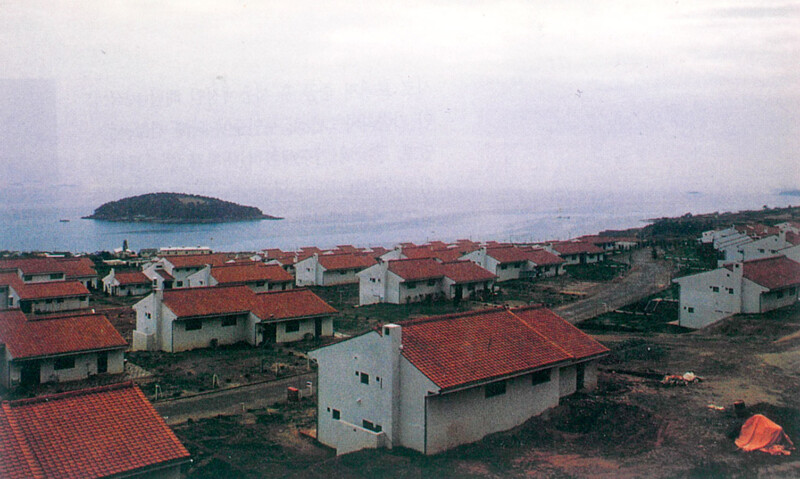
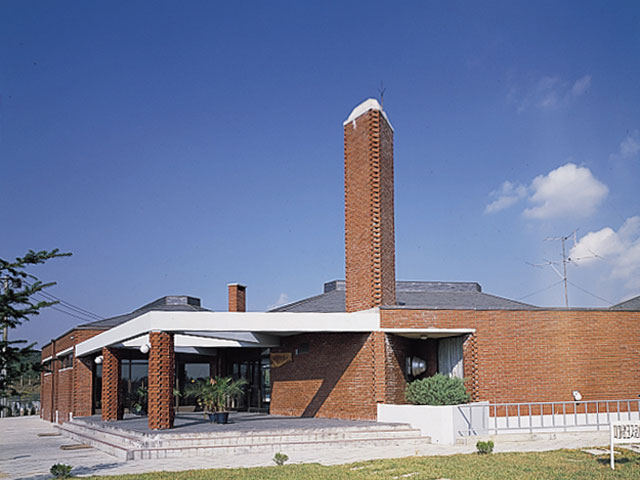
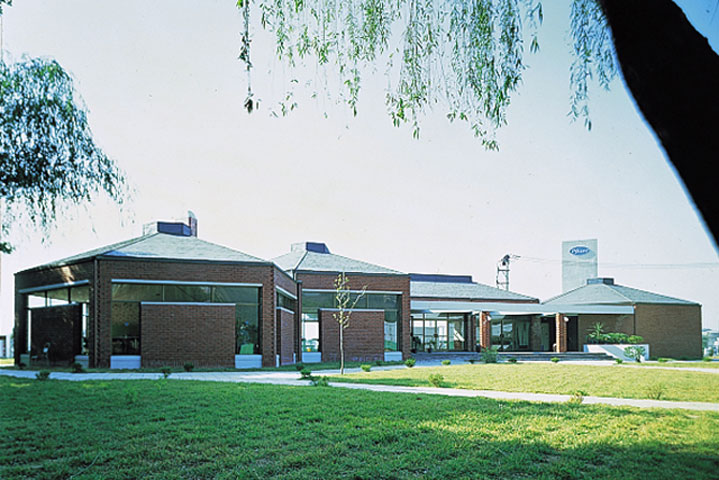
The Motorola Korea Saemaul Hall serves as a rest facility within a large-scale electronics factory, complemented by a tennis court and a future front-facing swimming pool as service amenities. To create a sanctuary for workers — a place of respite amid the industrial workspace of the factory — the building is positioned on a site elevated approximately 5 meters above the existing factory grounds, fully isolating it as a realm of relaxation. As a low-rise structure on this raised platform, its silhouette is designed to catch the sunset light naturally, forming a bright and vigorous cluster reminiscent of flags amid a tent encampment.
The interior rest spaces are composed of hexagonal cells as basic units, combined to foster connections between spaces while achieving spatial unity. In particular, the narrowed waist of the central canteen hall penetrates both the front vestibule and rear garden, lightly linking the front entrance to the verdant backyard garden while continuously drawing exterior light into the interior.

-
Status
Completed
-
Awards
- 1979 Seoul Architecture Award_Bronze Award
-
Client
Motorola Inc.
-
Program
Industrial, Hospitality
-
Design Year
1976
-
Completion Year
1977
-
Location
Seongdong-gu, Seoul
-
Site area
40,015m2
-
Gross Floor Area
576m2
-
Building Area
463m2
-
Number of Levels
B1, 1F
The Motorola Korea Saemaul Hall serves as a rest facility within a large-scale electronics factory, complemented by a tennis court and a future front-facing swimming pool as service amenities. To create a sanctuary for workers — a place of respite amid the industrial workspace of the factory — the building is positioned on a site elevated approximately 5 meters above the existing factory grounds, fully isolating it as a realm of relaxation. As a low-rise structure on this raised platform, its silhouette is designed to catch the sunset light naturally, forming a bright and vigorous cluster reminiscent of flags amid a tent encampment.
The interior rest spaces are composed of hexagonal cells as basic units, combined to foster connections between spaces while achieving spatial unity. In particular, the narrowed waist of the central canteen hall penetrates both the front vestibule and rear garden, lightly linking the front entrance to the verdant backyard garden while continuously drawing exterior light into the interior.