Industry 4.0
The necessity of digital transformation
Toward an opportunity for leaps
A change in “approach” beyond “tools”
The construction industry has traditionally been considered one of the sectors slowest to embrace digital transformation compared to other industries. This was due to its field-centered, labor-intensive nature and fragmented supply chain structure. However, the powerful wave of the Fourth Industrial Revolution is now knocking forcefully at the door of the once-solid construction and architectural design fields. The shortage of skilled workers due to population decline, carbon neutrality demands driven by rapid climate change, and increasingly complex building performance requirements have reached a limit that can no longer be resolved through conventional analog methods.
Moreover, the advent of AI has accelerated the timing for problem-solving. Artificial intelligence and big data have made it possible to efficiently control numerous variables. They process repetitive tasks accurately and quickly. Digital transformation has opened a tremendous “window of opportunity” to create advanced productivity and new value added. The time has come for the architectural design field to create an inflection point and leap beyond the limitations of the era. Junglim Architecture is now undergoing digital transformation (DT), questioning the familiar methods and processes it has employed thus far. Beyond merely changing tools, we are preparing for a new era of architecture through data-driven decision-making and process innovation. We propose four directions for the digital transformation of architecture. Starting from these four directions, we hope to contemplate and advance together toward better architecture.
Written by & Courtesy of Architect Sungwoo Ahn (Leader of the New Tech SU, Junglim Architecture)
Edited by the Brand Team of Junglim Architecture
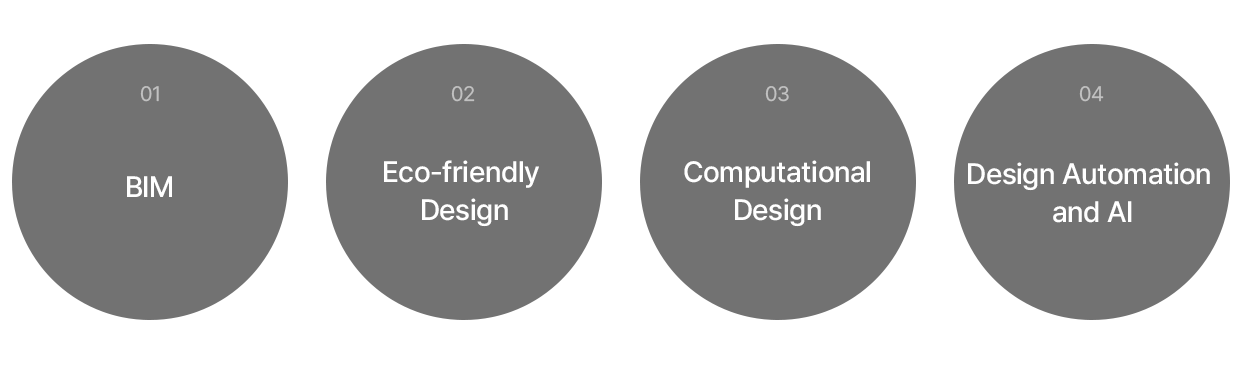
01 BIM
Beyond simple 3D modeling to an “integrated information platform”
The digitization of design work revolves around building information modeling (BIM), which is not merely a tool that converts 2D drawings into 3D forms for visual presentation, but one that delivers all information required throughout the architectural process in the best possible way. In other words, BIM is defined as a platform that encompasses all information generated over the building’s life cycle, from planning and design to construction and facility management (FM).
The systematic accumulation and utilization of BIM data will elevate the standard of design quality and serve as a foundation of trust by providing transparent and accurate information in practice and decision-making processes.
- Streamlined collaboration
Interference between trades such as architecture, structure, mechanical, and electrical is checked in advance to dramatically reduce design errors.
- Data continuity
Building an integrated pipeline is pursued so that data from the design phase can flow seamlessly into construction estimating and schedule management without interruption.
02 Eco-friendly Design
From intuition-based to “data-driven design”
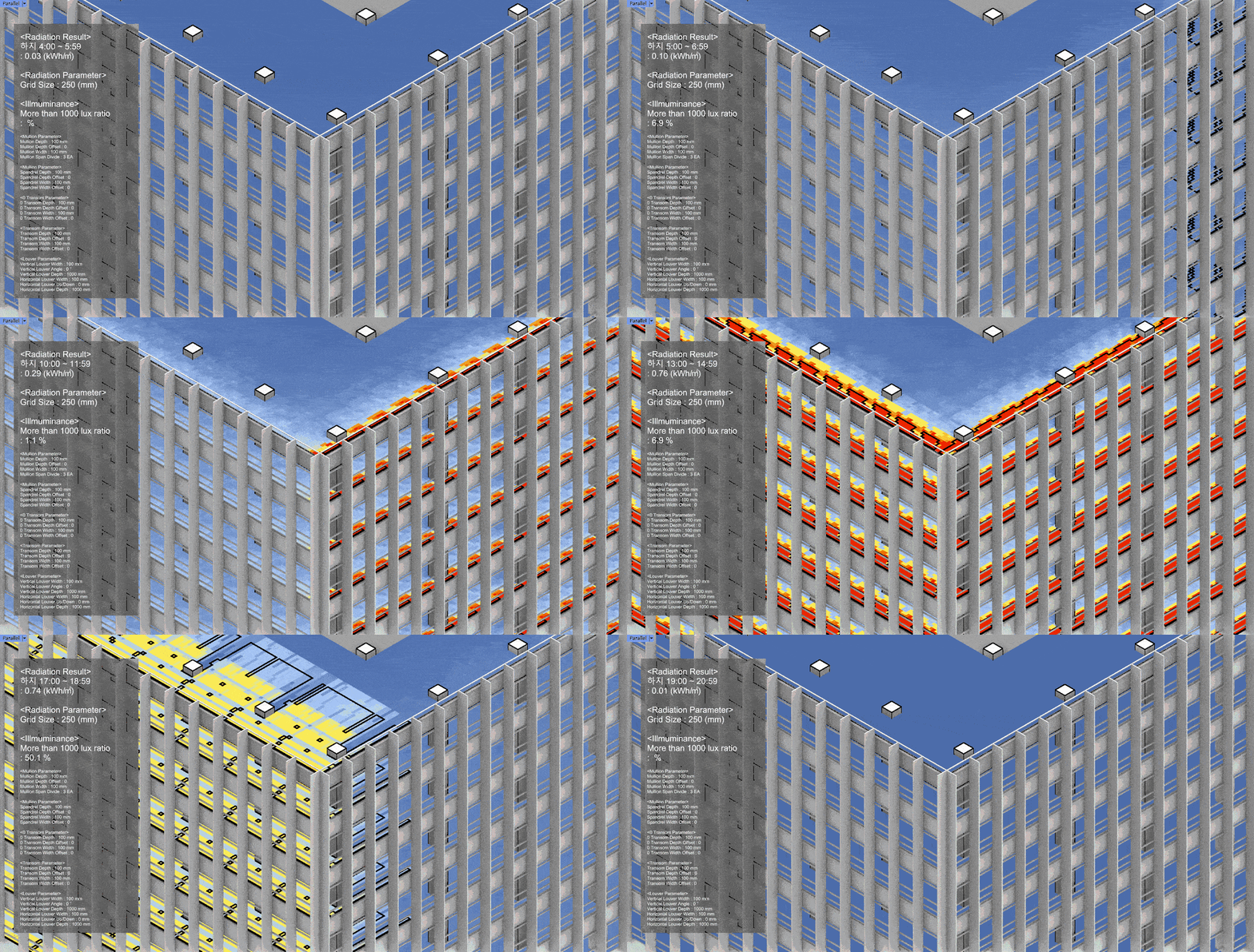
Sustainable architecture is no longer a choice but a necessity. While past eco-friendly design relied on designers’ intuition and experience, eco-friendly design in the DT era is grounded in clear “data” and “simulation”. Advanced environmental simulation techniques need to be actively introduced from the initial design phase of projects.
This approach not only provides clients with objective credibility, but also implements Junglim’s philosophy of fulfilling social responsibility through concrete technology.
- Quantitative analysis
Site airflow, solar radiation, light reflection, and energy performance are analyzed numerically to derive optimal layout and form.
- Evidence-based design
To the question “Why should the building take this form?” we provide rational answers not only through aesthetic value but also through quantified carbon emission reductions and energy efficiency.
03 Computational Design
The power of algorithms to control complexity
Contemporary buildings are becoming increasingly complex, demanding diverse capabilities from architects. To accommodate these circumstances while securing constructability and cost-effectiveness, the adoption of computational design is essential. Algorithm-based parametric design must be actively utilized. This is a core process that allows designers to move beyond simple, repetitive modification work and fully focus on creative ideation and improving design quality.
- Real-time feedback and flexible modification
Adjusting parameters enables the real-time control of the entire model’s geometry. This provides powerful flexibility to quickly review numerous design alternatives and immediately reflect client requirements.
- Consistency and data-driven efficiency
Shape data for curtain wall panels or structural members are automatically optimized to generate precise 3D data that minimizes construction errors.
04 Design Automation and AI
A “Smart Partner” that extends human creativity
Simple, repetitive, and rule-based design tasks are being dramatically improved through automation tools and artificial intelligence. AI is utilized as an auxiliary tool that extends designers’ capabilities. The introduction of AI shortens the design period and also serves as an opportunity to derive innovative design solutions that could not be discovered through familiar perspectives.
- Generative Design
AI-powered image generation assists in initial conception and architectural visualization proposals. Furthermore, by learning site conditions, regulations, floor area ratio, and other constraints, it instantly proposes massing study alternatives (mass studies, parking layouts, area schedules, etc.).
- Optimal decision-making
Designers perform the role of sophisticated decision-makers who select and develop the optimal solution from numerous options proposed by AI.
The essence of change
Lies in the “process,” not the “tool”
The ultimate goal of digital transformation pursued by Junglim Architecture is not simply using the latest software or flaunting flashy technology. The true essence of change lies not in “which tools to use” but in “how we work” — in other words, fundamental innovation of the work process. Digital tools can break down team barriers and create a communication culture where data flows transparently among all stakeholders. If a culture becomes established where thinking is grounded in data and collaboration occurs organically in cloud and digital environments, we can move toward ideal digital transformation. Through technology-based architectural design, Junglim Architecture seeks to create “healthy spatial environments,” supporting “a world of living together.”