
Close
![Popup Image]()
Given the current reality where facilities in public spaces are primarily commissioned by government agencies, the design of public buildings has traditionally been determined by a management-centric control system. In particular, libraries, due to the nature of books and their management systems, tend to feature a single mass and a uniform system.
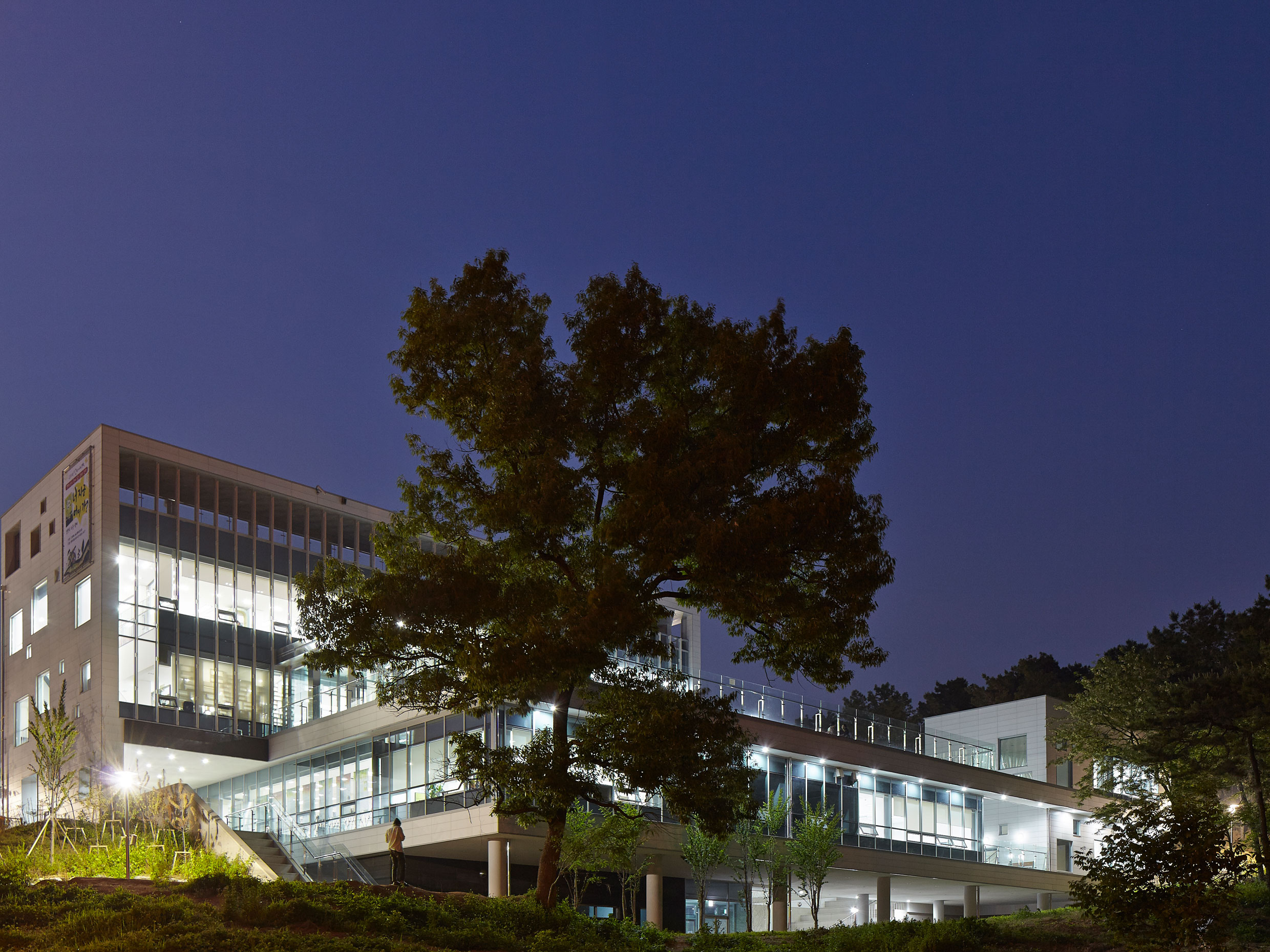
In contrast, the Pyeongtaek Library was planned to define a space dedicated solely to books on an “architectural mat” set within the site of a park, allowing both the interior and exterior of the building to be utilized as spaces for books. Although this is merely a small experiment, through the use of fragmented masses and spaces, we cautiously hope that this open library within a park will serve as a new paradigm for public buildings, allowing public spaces for citizens to become more spatially diverse and freely accessible in the future.


-
Status
Completed
-
Awards
- 2015 Gyeonggi Architecture Culture Award_Finalist
-
Order
Pyeongtaek City Library
-
Purpose
Public, Cultural
-
Design Year
2010
-
Completion Year
2014
-
Location
Pyeongtaek-si, Gyeonggi-do
-
Site area
5,944.69m2
-
Gross Floor Area
2,034.12m2
-
Building Area
1,237.05m2
-
Scale
B1, 3F
Given the current reality where facilities in public spaces are primarily commissioned by government agencies, the design of public buildings has traditionally been determined by a management-centric control system. In particular, libraries, due to the nature of books and their management systems, tend to feature a single mass and a uniform system.
In contrast, the Pyeongtaek Library was planned to define a space dedicated solely to books on an “architectural mat” set within the site of a park, allowing both the interior and exterior of the building to be utilized as spaces for books. Although this is merely a small experiment, through the use of fragmented masses and spaces, we cautiously hope that this open library within a park will serve as a new paradigm for public buildings, allowing public spaces for citizens to become more spatially diverse and freely accessible in the future.