
Close
![Popup Image]()
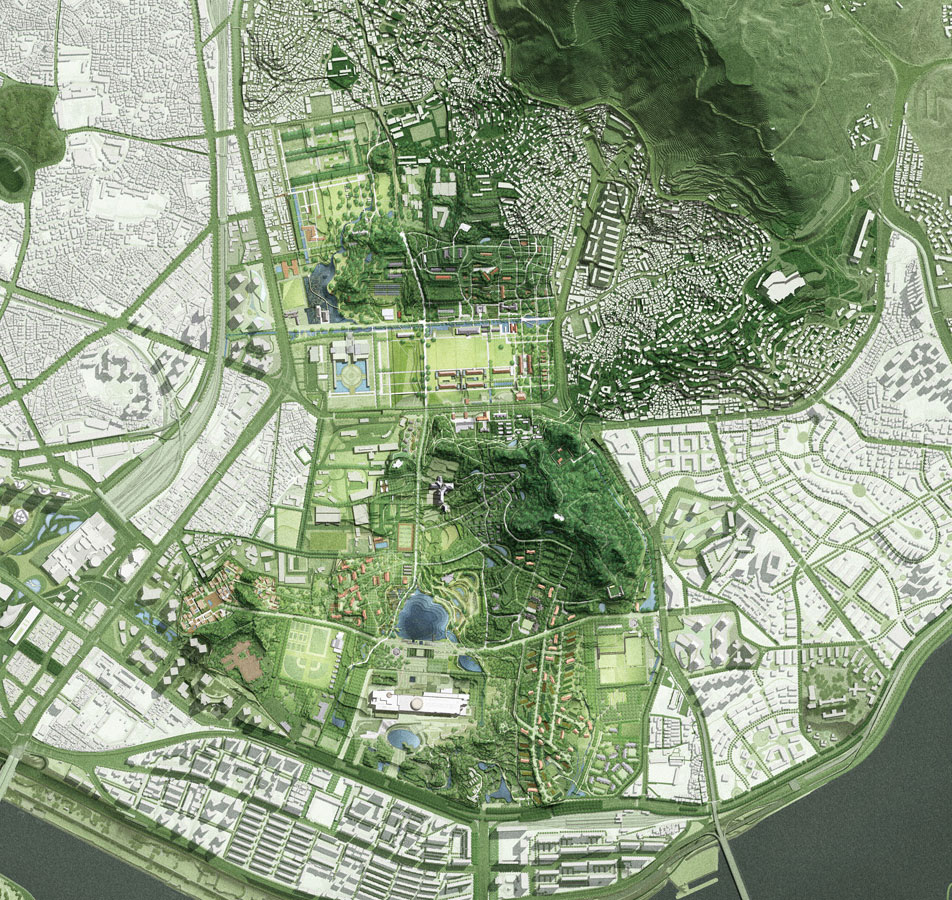
How do we understand the new patterns of urbanization in the 21st century? Global urbanization in the last century was driven by the Western model of modernization. However, Asian cities today offer a fundamentally different new model. Seoul, one of the fastest-growing cities, is a megacity with a population of over 10 million. As one of the world’s major cities, Seoul can be said to represent a new paradigm of modern urbanization. We can view this city through the lens of multiplicity. One of Seoul’s most intriguing spatial characteristics is that, despite rapid growth and urbanization, diverse natural environments still remain. In one of the world’s most highly developed cities, mountains, forests, and nature are easily accessible. High density and diversity are the key organizing elements of Seoul’s spatial structure. Just as with Seoul’s structure, the park program is arranged according to the logic of the land. Park programs that engage in direct dialogue with adjacent urban developments are located in lower-lying areas, while major ecological programs occupy higher elevations. The park system of high density and diversity generally follows the topography, which can be expressed as a vertical structure. The framework of high density and diversity is innovative and distinct from existing zones, requiring clear boundaries between spaces. Therefore, the spatial boundaries of the park are not defined, allowing for change and the creation of new dynamic spaces. We propose the construction of a new park based on this framework of high density and diversity.

-
Status
Completed
-
Client
Ministry of Land, Infrastructure and Transport
-
Program
Cultural
-
Design Year
2012
-
Location
Yongsan-gu, Seoul
-
Site area
2,430.00m2
How do we understand the new patterns of urbanization in the 21st century? Global urbanization in the last century was driven by the Western model of modernization. However, Asian cities today offer a fundamentally different new model. Seoul, one of the fastest-growing cities, is a megacity with a population of over 10 million. As one of the world’s major cities, Seoul can be said to represent a new paradigm of modern urbanization. We can view this city through the lens of multiplicity. One of Seoul’s most intriguing spatial characteristics is that, despite rapid growth and urbanization, diverse natural environments still remain. In one of the world’s most highly developed cities, mountains, forests, and nature are easily accessible. High density and diversity are the key organizing elements of Seoul’s spatial structure. Just as with Seoul’s structure, the park program is arranged according to the logic of the land. Park programs that engage in direct dialogue with adjacent urban developments are located in lower-lying areas, while major ecological programs occupy higher elevations. The park system of high density and diversity generally follows the topography, which can be expressed as a vertical structure. The framework of high density and diversity is innovative and distinct from existing zones, requiring clear boundaries between spaces. Therefore, the spatial boundaries of the park are not defined, allowing for change and the creation of new dynamic spaces. We propose the construction of a new park based on this framework of high density and diversity.