
Close
![Popup Image]()
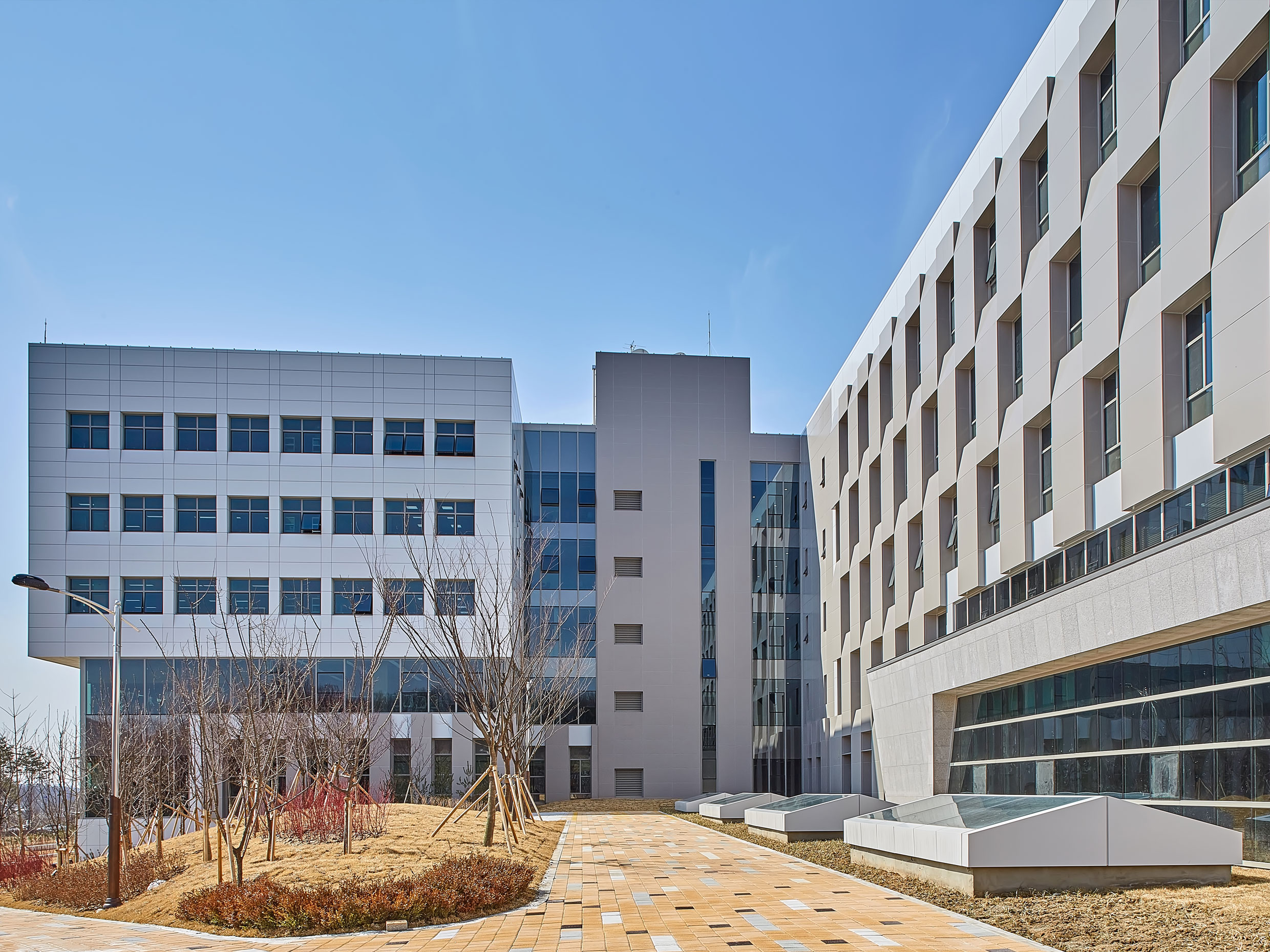
Established in 1972, the Korea Institute for Curriculum and Evaluation (KICE) is a research institute dedicated to the research and development of educational policies. In accordance with the government’s plan to relocate public institutions to regional areas, the institute is scheduled to move from its current headquarters in Umyeon-dong, Seoul, to the Chungbuk Innovation City.
This project, proposed as a technical proposal for the basic design, creatively fulfills the requirements for the new headquarters through four architectural concepts.
First, EDU: As an educational and research facility, it provides amenities for researchers and features a clear zoning plan between programs.
Second, ECO: It realizes an ultra-energy-efficient headquarters that leads the Chungbuk Innovation City through the incorporation of various eco-friendly elements.
Third, ECONOMY: Plans to reduce maintenance and energy costs through a smart system capable of intelligent integrated management.
Fourth, E-CUBE: Conveying the symbolic significance of the Education Development Institute by incorporating metal movable type—a symbol of knowledge and the foundation of a world-class research institution—into the facade design.


-
Status
Completed
-
Order
KUMHO Engineering & Construction Co., Ltd.
-
Purpose
Public, Office
-
Design Year
2013
-
Completion Year
2017
-
Location
Jincheon-gun, Chungcheongbuk-do
-
Site area
24000.00m2
-
Gross Floor Area
26080.28m2
-
Building Area
5582.66m2
-
Scale
B1, 5F
Established in 1972, the Korea Institute for Curriculum and Evaluation (KICE) is a research institute dedicated to the research and development of educational policies. In accordance with the government’s plan to relocate public institutions to regional areas, the institute is scheduled to move from its current headquarters in Umyeon-dong, Seoul, to the Chungbuk Innovation City.
This project, proposed as a technical proposal for the basic design, creatively fulfills the requirements for the new headquarters through four architectural concepts.
First, EDU: As an educational and research facility, it provides amenities for researchers and features a clear zoning plan between programs.
Second, ECO: It realizes an ultra-energy-efficient headquarters that leads the Chungbuk Innovation City through the incorporation of various eco-friendly elements.
Third, ECONOMY: Plans to reduce maintenance and energy costs through a smart system capable of intelligent integrated management.
Fourth, E-CUBE: Conveying the symbolic significance of the Education Development Institute by incorporating metal movable type—a symbol of knowledge and the foundation of a world-class research institution—into the facade design.