
Close
![Popup Image]()
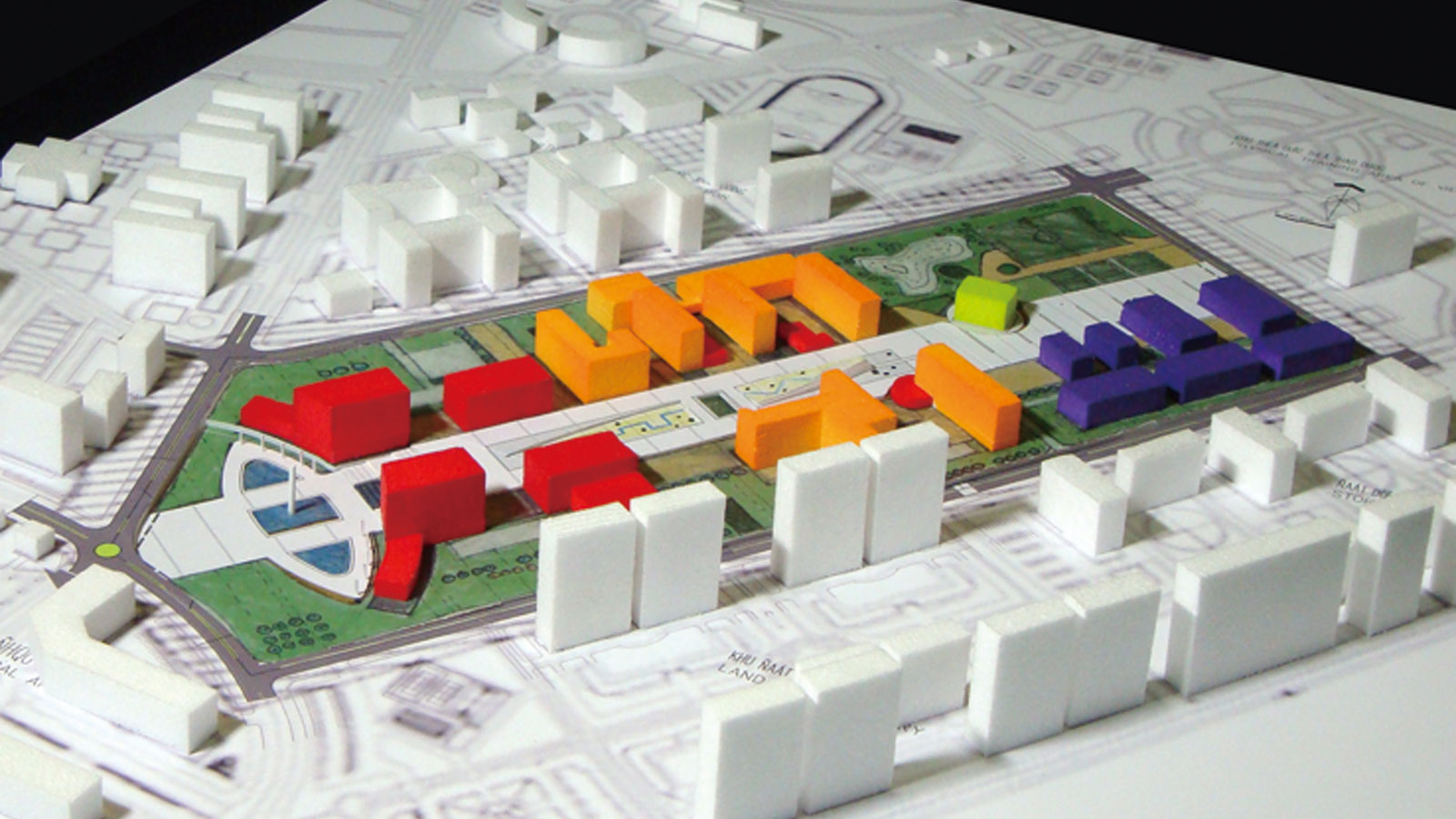
The campus master plan for Ho Chi Minh City University of Technology (HCMUT) is structured around three main components.
First, it plans the campus’s symbolic landscape through “Axis Key Points,” thereby establishing a new identity for the entire campus in terms of layout and building forms.
Second, the “Quad Character” approach involves creating basic cells—small-scale quads—that reflect the characteristics of specific departments or facilities, and establishing the spatial framework of the overall master plan through the interconnection of these cells.
Third, “Context Nature” utilizes the most fundamental conditions of the site environment, actively incorporating them into the master plan from the initial design phase and employing them as key elements in layout and form. This is an indispensable element for creating an environmentally friendly campus that harmonizes with the surrounding context by reflecting local characteristics.
Through these three approaches, Ho Chi Minh City University of Technology (HCMUT) will be developed into a campus that embodies a new identity, a spatial system reflecting the university’s characteristics, and the local distinctiveness of Dian.


-
Status
Completed
-
Order
Ho Chi Minh Information Technology University
-
Purpose
Education, R&D
-
Design Year
2013
-
Location
Ho Chi Minh City, Vietnam
-
Site area
260,579.00m2
-
Gross Floor Area
199,283.00m2
-
Building Area
48,805.00m2
-
Scale
8F
The campus master plan for Ho Chi Minh City University of Technology (HCMUT) is structured around three main components.
First, it plans the campus’s symbolic landscape through “Axis Key Points,” thereby establishing a new identity for the entire campus in terms of layout and building forms.
Second, the “Quad Character” approach involves creating basic cells—small-scale quads—that reflect the characteristics of specific departments or facilities, and establishing the spatial framework of the overall master plan through the interconnection of these cells.
Third, “Context Nature” utilizes the most fundamental conditions of the site environment, actively incorporating them into the master plan from the initial design phase and employing them as key elements in layout and form. This is an indispensable element for creating an environmentally friendly campus that harmonizes with the surrounding context by reflecting local characteristics.
Through these three approaches, Ho Chi Minh City University of Technology (HCMUT) will be developed into a campus that embodies a new identity, a spatial system reflecting the university’s characteristics, and the local distinctiveness of Dian.