
Close
![Popup Image]()
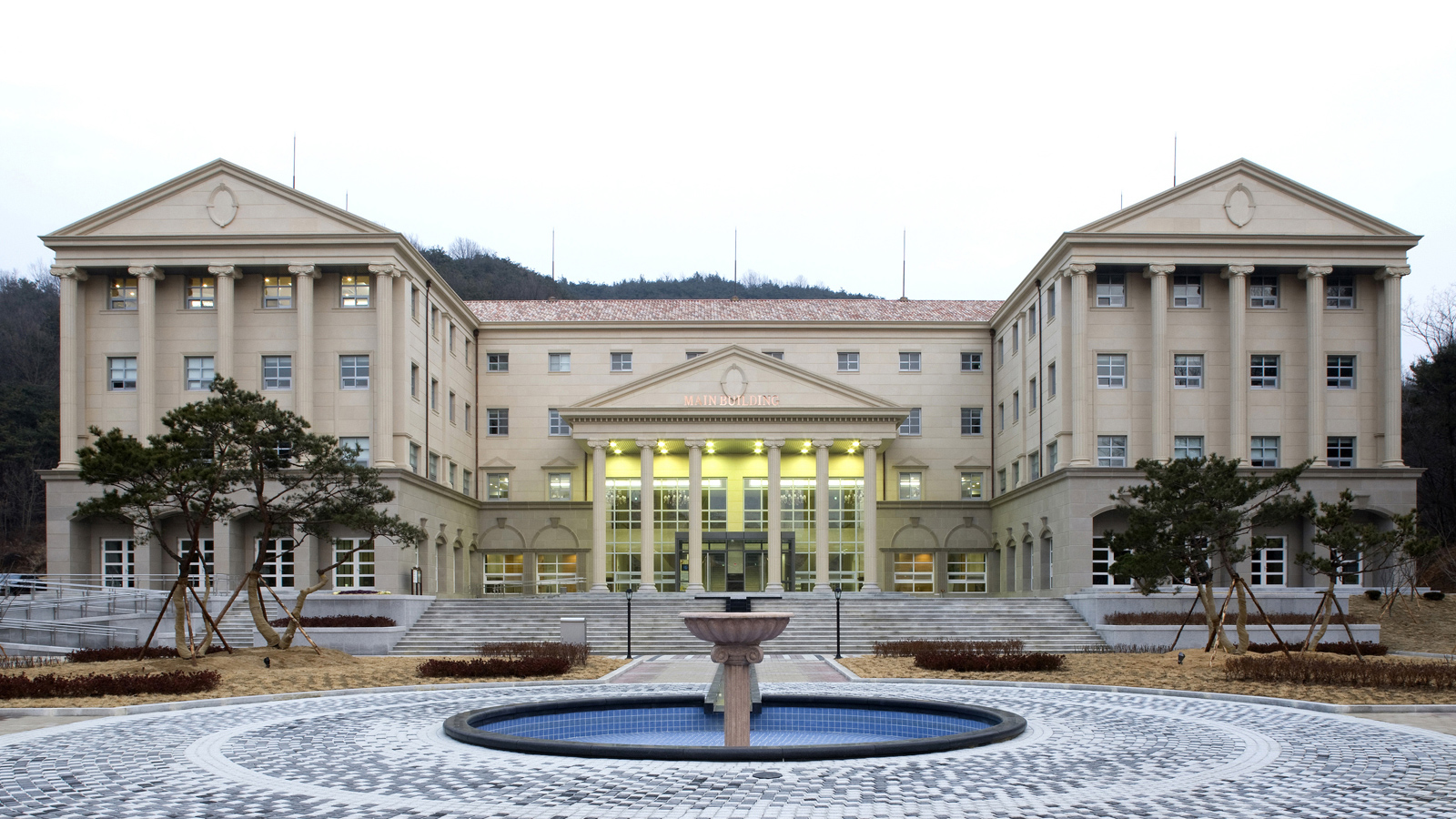
The English Village is composed of “familiarity zones” designed to provide a comfortable English-language experience by replicating typical environments found in English-speaking countries. These “spaces of familiarity” consist of spatial elements such as buildings, freestanding signs, and road signs that tell various stories, making learners feel as though they are in a fully English-speaking environment. They are broadly divided into a “Situation Town” for experiencing English-speaking culture, a “Campus Town” for learning, and living facilities for accommodation and meals. At the center of this complex lies a circular main plaza that serves as a hub and a point of connection.
These functional spaces are places where people and space interact, and they serve as repositories of images imbued with the memories of events that have taken place there. To move beyond textbook-centered education, students must acquire the English necessary for real-life situations not through rote memorization, but through actual experience. To achieve this, an environment must be created where students can experience the diversity of real-life situations in a foreign country, and this space must maintain diversity not only physically but also temporally and seasonally.


-
Status
Completed
-
Order
YJ Education Foundation
-
Purpose
Education, Hospitality
-
Design Year
2005
-
Completion Year
2007
-
Location
Chilgok-gun, Gyeongsangbuk-do
-
Site area
29,940.00m2
-
Gross Floor Area
26,006.00m2
-
Scale
B2, 5F
The English Village is composed of “familiarity zones” designed to provide a comfortable English-language experience by replicating typical environments found in English-speaking countries. These “spaces of familiarity” consist of spatial elements such as buildings, freestanding signs, and road signs that tell various stories, making learners feel as though they are in a fully English-speaking environment. They are broadly divided into a “Situation Town” for experiencing English-speaking culture, a “Campus Town” for learning, and living facilities for accommodation and meals. At the center of this complex lies a circular main plaza that serves as a hub and a point of connection.
These functional spaces are places where people and space interact, and they serve as repositories of images imbued with the memories of events that have taken place there. To move beyond textbook-centered education, students must acquire the English necessary for real-life situations not through rote memorization, but through actual experience. To achieve this, an environment must be created where students can experience the diversity of real-life situations in a foreign country, and this space must maintain diversity not only physically but also temporally and seasonally.