Close
![Popup Image]()
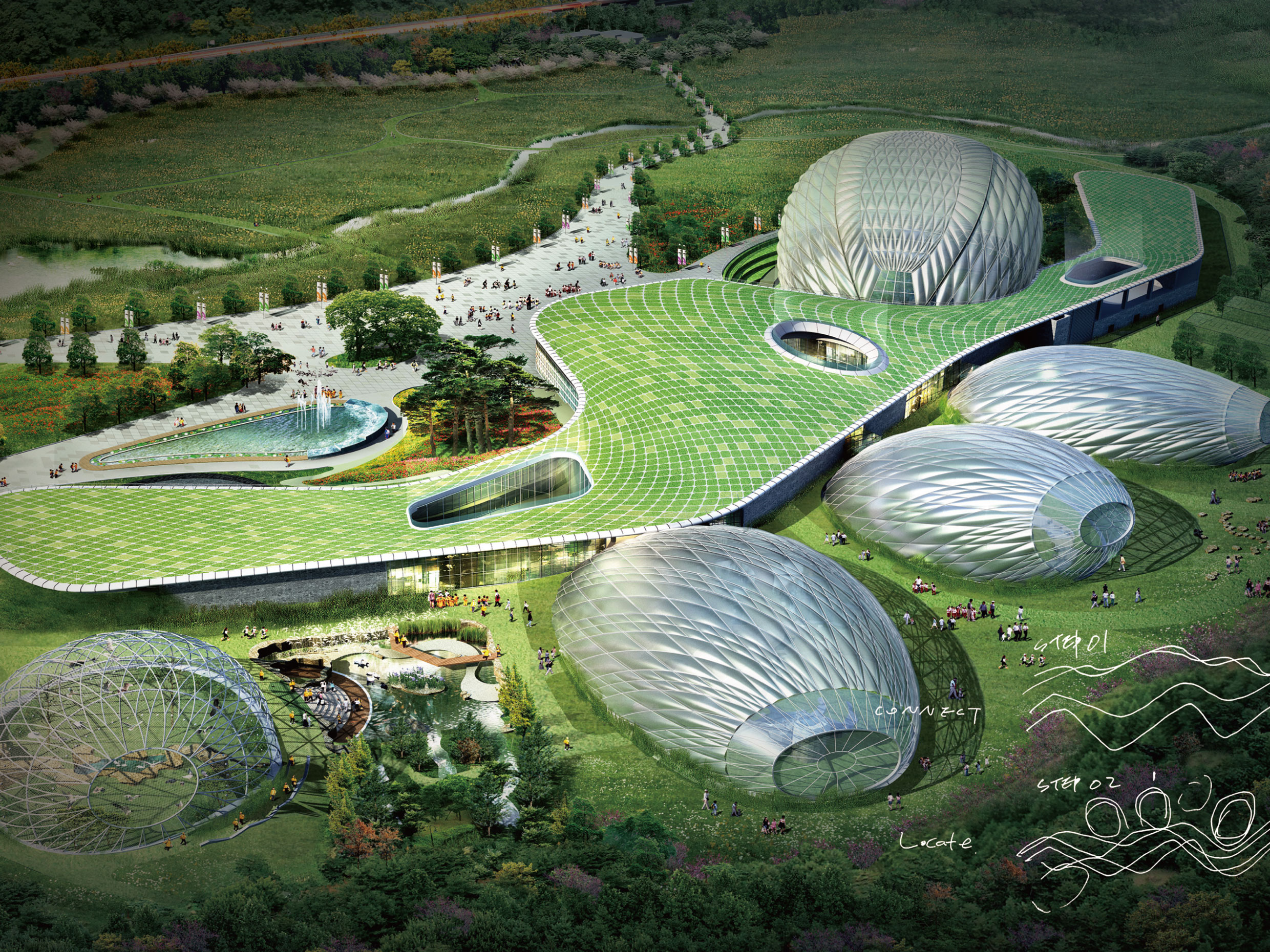
National Institute of Ecology is a place where visitors experience entire ecosystems and reflect on the future of the Earth, coming to realize that humans are not the only owners of the planet. In this ecological park, where the cyclical structure of ecosystems is experienced and taught, particular attention was paid to the fact that, although many areas have been converted into farmland by humans, there still remain places in their original natural state. Seocheon, with its mudflats that serve as resting grounds for migratory birds and its estuary where the sea and river meet, offered abundant nature-friendly symbols drawn from its diverse ecosystems. Accordingly, the design approach to the site began with preserving existing vegetation and seeking forms shaped by considerations of energy.
A variety of circulation flows were explored so that visitors could travel through and experience all of the Earth’s ecosystems, becoming one with nature through direct encounter and interaction. As band-type circulation that emphasizes one-way movement, pocket-type circulation that strongly links indoor and outdoor exhibitions, and flow-type circulation that fully engages the natural contours of the site were developed, the Institute came to be conceived as both a miniature version of the entire Earth and a unique place where the flow of nature is not artificially obstructed.
The method of viewing and experiencing living exhibits prompted reflection not so much on the convenience of human circulation and facility management, but on relationships with the other living beings that share the space and on elements that may be inconvenient for humans yet essential for vegetation. This project thus became an opportunity to experience architecture as something not designed solely for humans.


-
Status
Unrealized
-
Order
Ministry of Environment
-
Purpose
Cultural, Public
-
Design Year
2009
-
Location
Seocheon-gun, Chungcheongnam-do
-
Site area
75,785.00m2
-
Gross Floor Area
34,490.67m2
-
Building Area
25,061.12m2
-
Scale
B1, 2F
National Institute of Ecology is a place where visitors experience entire ecosystems and reflect on the future of the Earth, coming to realize that humans are not the only owners of the planet. In this ecological park, where the cyclical structure of ecosystems is experienced and taught, particular attention was paid to the fact that, although many areas have been converted into farmland by humans, there still remain places in their original natural state. Seocheon, with its mudflats that serve as resting grounds for migratory birds and its estuary where the sea and river meet, offered abundant nature-friendly symbols drawn from its diverse ecosystems. Accordingly, the design approach to the site began with preserving existing vegetation and seeking forms shaped by considerations of energy.
A variety of circulation flows were explored so that visitors could travel through and experience all of the Earth’s ecosystems, becoming one with nature through direct encounter and interaction. As band-type circulation that emphasizes one-way movement, pocket-type circulation that strongly links indoor and outdoor exhibitions, and flow-type circulation that fully engages the natural contours of the site were developed, the Institute came to be conceived as both a miniature version of the entire Earth and a unique place where the flow of nature is not artificially obstructed.
The method of viewing and experiencing living exhibits prompted reflection not so much on the convenience of human circulation and facility management, but on relationships with the other living beings that share the space and on elements that may be inconvenient for humans yet essential for vegetation. This project thus became an opportunity to experience architecture as something not designed solely for humans.