Close
![Popup Image]()
At a typical business hotel, the experience is limited to arriving at the lobby on the first floor, checking in, taking the elevator, and walking down the hallway to your room. The Courtyard by Marriott in Godeok International New Town began with the question: “Can the journey to the guest room be interesting and varied, even in a business hotel?” Aiming to transcend the limitations of a typical urban business hotel, the project envisioned a workspace that offers more than just business—one where guests can relax and enjoy leisure activities through a variety of amenities, outdoor courtyards, and terraces.
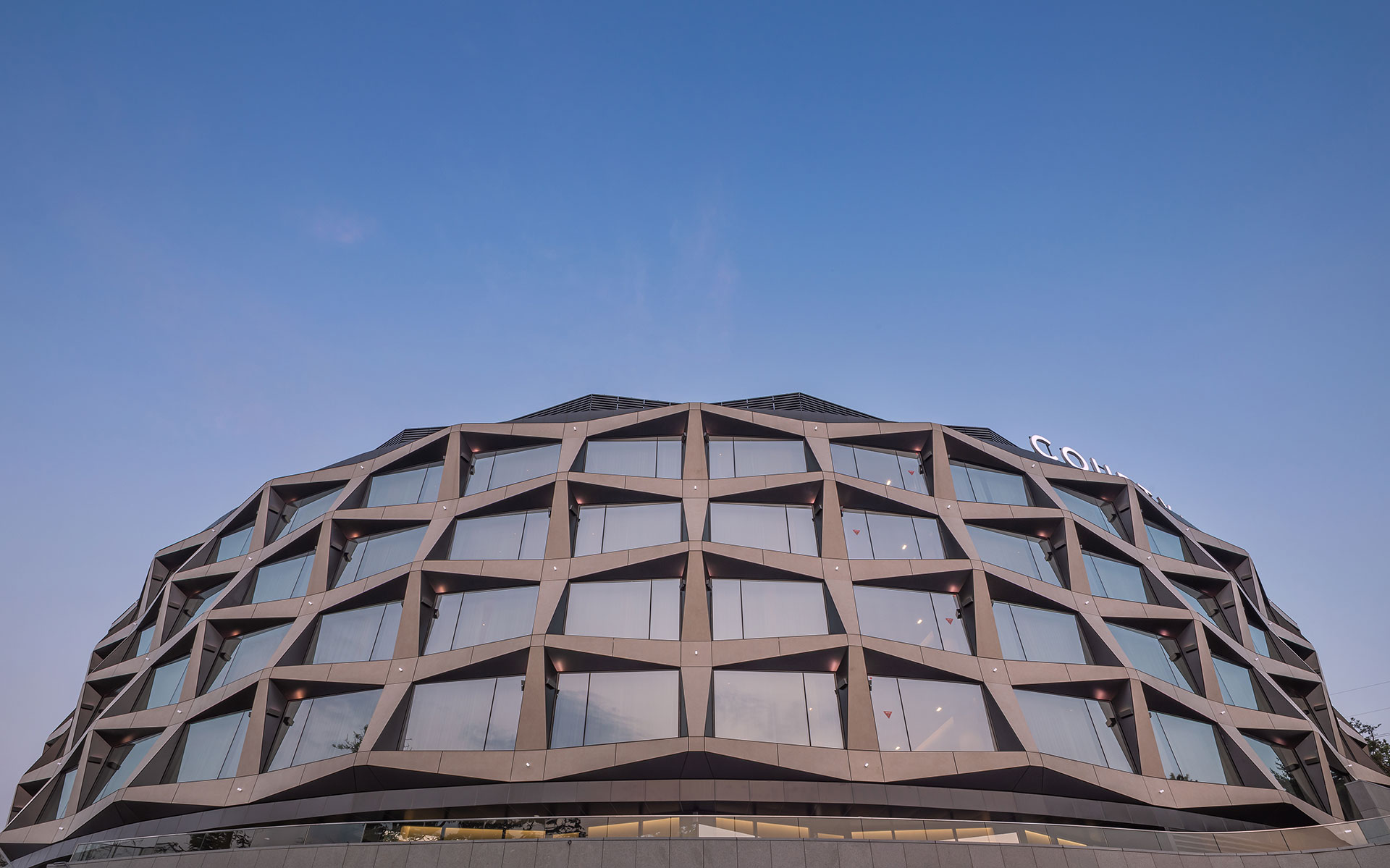
Located on a small, undulating hill in an area undergoing urbanization, the hotel’s design rejected the typical linear layout of a podium and corridor from the outset. Instead, it adopted a circular layout to maximize views of both Pyeongtaek’s old downtown and the Godeok New Town. The building consists of modules arranged at 12-degree intervals, forming a complete 360-degree circle, ensuring that every guest room enjoys a view. By placing the large-scale banquet hall and swimming pool at the center of the circular podium, the compact building layout minimized damage to the natural environment. The interior was designed with a single-corridor layout so that guests can always see a quiet and orderly inner courtyard while moving through the building. The radial structure and façade were designed with repetitive elements to improve constructability. In particular, the façade was conceived with the idea of making the time spent at the hotel valuable; it features a three-dimensional cutting technique reminiscent of the handcrafted bezel of a watch, creating new visual scenes through light from various angles. The circular design, uniquely achieved through three-dimensional panel arrangements, and the compact mass promote energy conservation and ensure the building functions as an eco-friendly structure even during the development process.
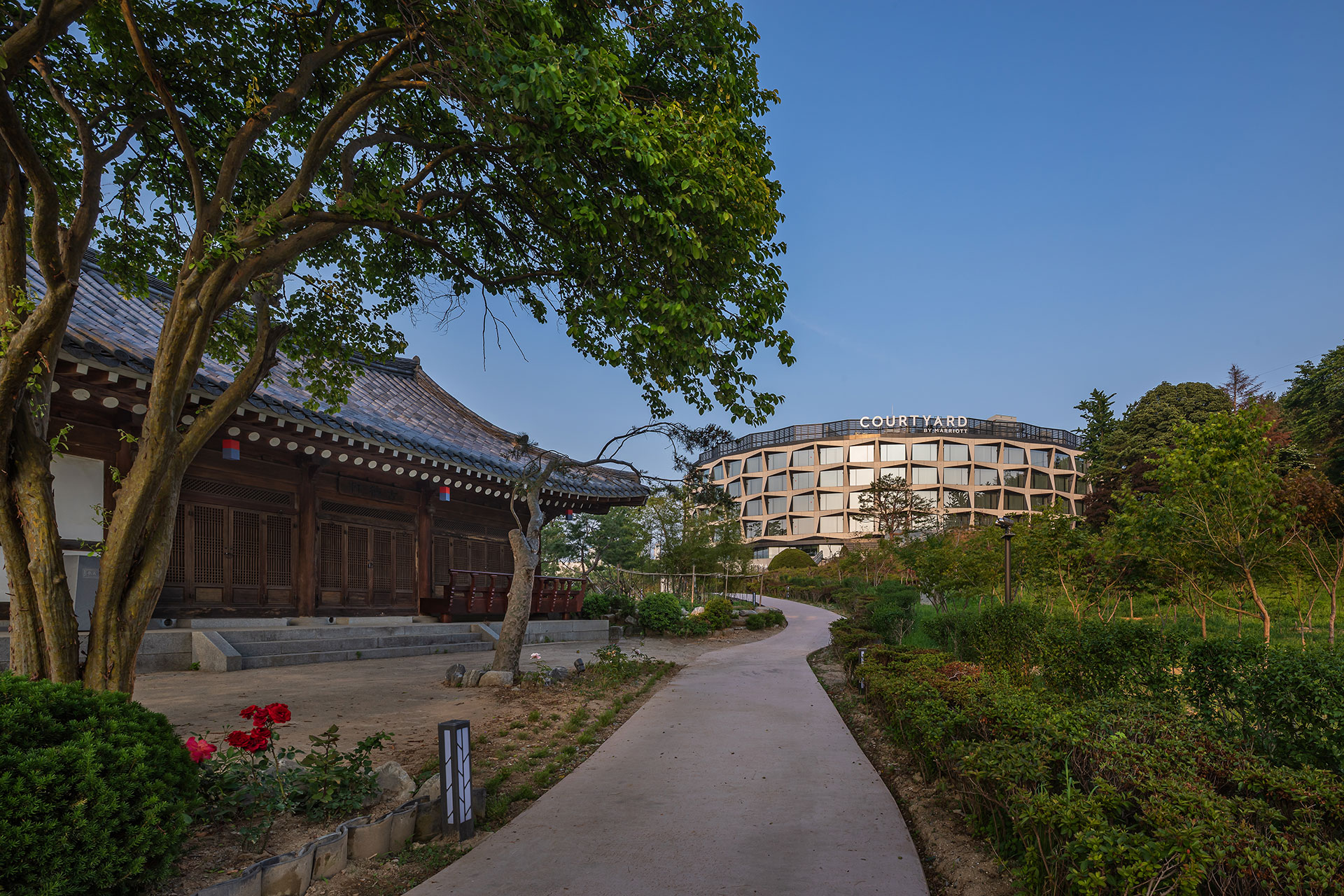
The first building guests encounter upon entering the hotel, accessed via an outdoor promenade and garden, is a remodeled hanok (traditional Korean house) designed to blend with the traditional landscaping and the scenery of the nearby small hill. Passing through the hanok, guests enter a quiet, dimly lit atmosphere in the lower pilotis drop-off area of the circular building before taking the escalator, which opens upward, to the main lobby. The lobby is a bright space that provides access to all of the hotel’s amenities, housed within a five-story atrium. After checking in within the atrium’s void space, guests move to their destination floor via the vertical core, where they can admire the interior courtyard along the corridor as they enter their rooms. Nicknamed “Rabbit Hole,” the hotel seeks answers from the earth and infuses them with novelty to deliver a delightful and entertaining experience.


-
Status
Completed
-
Order
Dongseung Leisure
-
Purpose
Hospitality
-
Design Year
2022
-
Completion Year
2025
-
Location
Pyeongtaek-si, Gyeonggi-do
-
Site area
24,162.00m2
-
Gross Floor Area
21,967.78m2
-
Building Area
5,827.93m2
-
Scale
B2, 4F
-
Architecture
At a typical business hotel, the experience is limited to arriving at the lobby on the first floor, checking in, taking the elevator, and walking down the hallway to your room. The Courtyard by Marriott in Godeok International New Town began with the question: “Can the journey to the guest room be interesting and varied, even in a business hotel?” Aiming to transcend the limitations of a typical urban business hotel, the project envisioned a workspace that offers more than just business—one where guests can relax and enjoy leisure activities through a variety of amenities, outdoor courtyards, and terraces.
Located on a small, undulating hill in an area undergoing urbanization, the hotel’s design rejected the typical linear layout of a podium and corridor from the outset. Instead, it adopted a circular layout to maximize views of both Pyeongtaek’s old downtown and the Godeok New Town. The building consists of modules arranged at 12-degree intervals, forming a complete 360-degree circle, ensuring that every guest room enjoys a view. By placing the large-scale banquet hall and swimming pool at the center of the circular podium, the compact building layout minimized damage to the natural environment. The interior was designed with a single-corridor layout so that guests can always see a quiet and orderly inner courtyard while moving through the building. The radial structure and façade were designed with repetitive elements to improve constructability. In particular, the façade was conceived with the idea of making the time spent at the hotel valuable; it features a three-dimensional cutting technique reminiscent of the handcrafted bezel of a watch, creating new visual scenes through light from various angles. The circular design, uniquely achieved through three-dimensional panel arrangements, and the compact mass promote energy conservation and ensure the building functions as an eco-friendly structure even during the development process.
The first building guests encounter upon entering the hotel, accessed via an outdoor promenade and garden, is a remodeled hanok (traditional Korean house) designed to blend with the traditional landscaping and the scenery of the nearby small hill. Passing through the hanok, guests enter a quiet, dimly lit atmosphere in the lower pilotis drop-off area of the circular building before taking the escalator, which opens upward, to the main lobby. The lobby is a bright space that provides access to all of the hotel’s amenities, housed within a five-story atrium. After checking in within the atrium’s void space, guests move to their destination floor via the vertical core, where they can admire the interior courtyard along the corridor as they enter their rooms. Nicknamed “Rabbit Hole,” the hotel seeks answers from the earth and infuses them with novelty to deliver a delightful and entertaining experience.